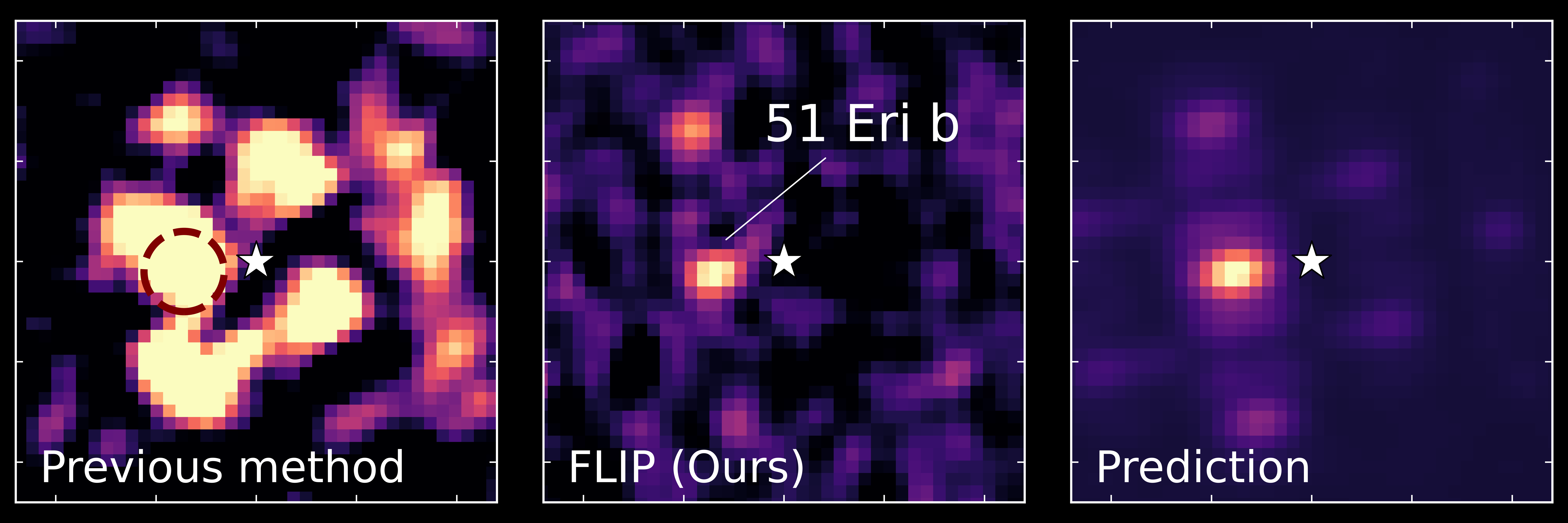
Adapted from Figure 2 from paper: Giant planet 51 Eridani b revealed with FLIP.
Summary
A major challenge in exoplanet imaging is to effectively remove starlight from our observations while keeping the light from the planet. Due to planets being orders-of-magnitude fainter than their host star, even small residuals of starlight can hide a planet.
I lead the development of FLIP: a framework using modern computational tools and explicit instrument models to reveal much fainter planets than we were able before. Our first work demonstrating this on real, on-sky data was published in Nature, where we apply it to the JWST/NIRCam coronagraphs. You can read the paper here.
I am Principal Investigator of a Cycle 4 JWST program (AR 7942) and a Cycle 5 JWST Legacy program (AR 11751) aiming to further develop and apply this framework. We have several exciting results coming up soon, so stay tuned for our future papers!
Paper abstract
Exoplanet imaging is the main method for detailed characterization of planets orbiting beyond 1 au, but it requires suppressing the bright glare of the star to see the faint planet light. As well as sophisticated instrumentation, effective image processing is necessary for starlight suppression, which continues to be a substantial limitation. Standard algorithms use reference images for starlight modelling and thus they are limited by inevitable telescope instabilities that change from reference to science observation. Addressing this challenge will increase the number of planets amenable to direct imaging and will be a notable step towards imaging exo-Earths with future observatories.
Here we present a new physics-based method for starlight subtraction. Our method combines a multistep optimization with a flexible physical model to produce a starlight model, allowing modelling and compensation of instrument instabilities. We use automatic differentiation (autodiff) to optimize millions of model parameters. We demonstrate our method on observations from the James Webb Space Telescope (JWST) Near-InfraRed Camera (NIRCam) coronagraph instrument. We achieve sensitivity 2–15 times superior to standard techniques, including the first detection of 51 Eridani b at 4.3 μm.
This is the first time, to our knowledge, that such an approach has demonstrated substantially improved sensitivity on real, on-sky coronagraphic imaging. Our framework can be extended to other current and future ground-based and space-based observatories, including the Nancy Grace Roman Space Telescope and the Habitable Worlds Observatory (HWO), potentially relaxing the unprecedented stability requirements needed to make these a success.
Selected media coverage
- Nature Research Briefing: Faint exoplanets detected using computational approach to remove glare from stars (article link)
- Science: Astronomers sharpen JWST’s view of distant worlds (article link)
- Scientific American: NASA’s James Webb Space Telescope is wobbly—scientists have a fix that could reveal new alien worlds (article link)
- NPR All Things Considered: This week in science: PTSD prediction, phishing while tired, an exoplanet (episode link)
Citation
Ferrer-Chavez, R., Wang, J.J., Bouman, K.L. et al. Imaging exoplanets below the telescope stability limit. Nature 659, 58–62 (2026). https://doi.org/10.1038/s41586-026-11213-z
@ARTICLE{ferrerchavez2026b,
       author = {{Ferrer-Chavez}, Rodrigo and {Wang}, Jason J. and {Bouman}, Katherine L. and {Freeman}, William T. and {Pueyo}, Laurent and {Feng}, Brandon Y. and {Perrin}, Marshall D.},
        title = "{Imaging exoplanets below the telescope stability limit}",
      journal = {\nat},
     keywords = {Physical Sciences, Astronomical and Space Sciences, Information and Computing Sciences, Artificial Intelligence and Image Processing},
         year = 2026,
        month = nov,
       volume = {659},
       number = {8139},
        pages = {58-62},
          doi = {10.1038/s41586-026-11213-z},
       adsurl = {https://scixplorer.org/abs/2026Natur.659...58F},
      adsnote = {Provided by the SAO/NASA Astrophysics Data System}
}